
The Future of Hospital Payments: From Cash Counters to Digital Payment Links
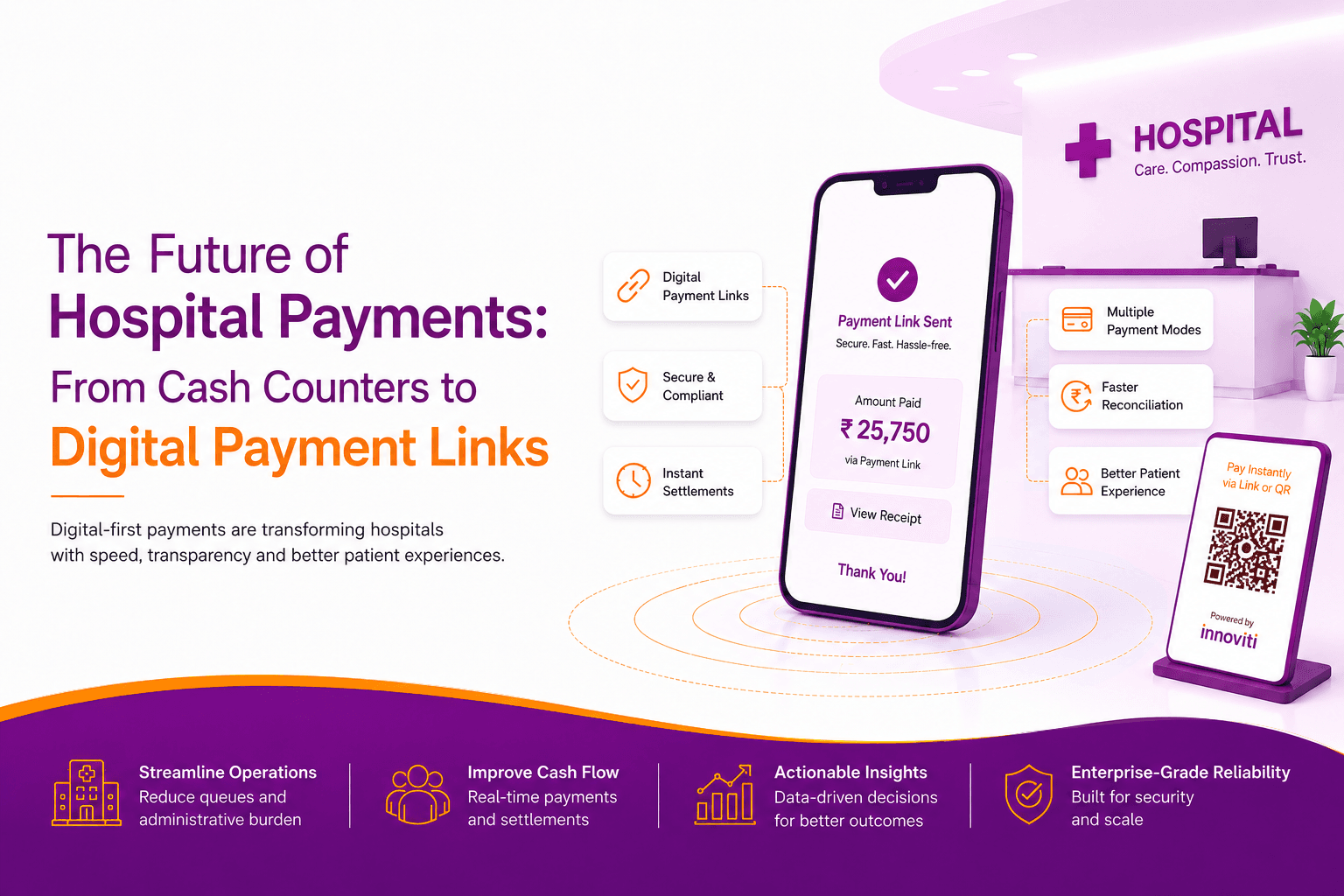
Walk into any busy hospital, and you’ll notice something interesting. Doctors are using advanced diagnostic tools. Medical records are available digitally. Appointments can be booked online. Yet, when it’s time to pay the bill, many hospitals still depend on conventional payment processes involving cash, POS terminals, and static QR codes.
For many patients, the final step of their hospital visit is also the most frustrating. A patient waiting to be discharged sits with packed bags while a family member stands in a billing queue. Another attendant runs between the pharmacy, diagnostic centre, and billing counter to complete multiple payments. Meanwhile, the finance team spends hours reconciling cash, card transactions, and UPI payments at the end of the day.
The quality of healthcare may have changed dramatically over the years. The payment experience, in many hospitals, hasn’t. That is beginning to change.
Hospital Payments Influence More Than Just Collections
Hospital payments are often seen as a finance function. In reality, they affect the entire patient journey. Every hospital manages hundreds, or even thousands, of payments every day. Registration fees, diagnostic tests, pharmacy bills, insurance co-payments, and discharge bills all pass through the billing team.
When these payments happen smoothly, patients leave with a positive experience, billing teams spend less time handling manual work, and hospital operations continue without unnecessary interruptions. But when payments become slow or complicated, the effects are felt everywhere. Patients wait longer to go home, families become anxious, and billing staff spend valuable time following up on payments instead of helping patients.
In many cases, the last interaction a patient has with the hospital is not with a doctor—it is at the billing counter. That experience often shapes how they remember the hospital.
Why Traditional Payment Methods Are No Longer Enough
Cash, POS machines, and static QR codes have served hospitals well for many years. But today’s healthcare environment demands greater flexibility.
Consider a common situation. A patient’s son is in Bengaluru while the patient is admitted in Kolkata. A surgery deposit needs to be paid immediately. The family is able to arrange part of the amount, but is still short of the required deposit. They begin reaching out to relatives living in different cities to arrange the remaining amount for treatment. In such situations, a static QR code offers limited flexibility, especially when different payment options are needed to complete the payment.
Similarly, POS machines only work when the person making the payment is physically present at the hospital. They offer little flexibility when payments need to be collected remotely or shared among multiple family members. These are no longer rare situations. They have become part of everyday hospital operations.
Patients Expect Payment Options That Fit Their Lives
Healthcare costs are becoming increasingly out-of-pocket, especially for diagnostics, specialty treatments, and insurance co-payments. Most families are willing to pay for quality healthcare. What often creates difficulty is arranging the full amount immediately.
Think about how people manage most household expenses today. They use UPI for everyday payments, credit cards for larger purchases, and, when needed, EMI to spread the cost over time. When they come to a hospital, they expect the same convenience.
If the only option available at the billing counter is a one-time payment, it creates unnecessary stress during an already emotional situation. When payment options align better with a family’s financial situation, treatment decisions are less likely to be delayed by payment-related concerns.
Why Payment Links Are Changing Hospital Billing
Rather than relying only on payments at the billing counter, hospitals can generate a secure payment link and send it directly to the patient’s or family member’s mobile via WhatsApp or SMS. The recipient can review the payment request and complete the transaction using UPI, a credit card, or eligible EMI options, helping simplify the billing process and reduce time spent at the counter.
The benefits go far beyond convenience. Registration payments can be completed before the patient reaches the counter. Discharge bills can be paid while discharge formalities are being completed.
Family members in another city can contribute instantly without travelling to the hospital. Even insurance co-payments can be collected without delaying the patient’s discharge. Instead of making patients adapt to the billing process, payment links allow the billing process to adapt to patients.
Making Hospital Payments More Secure
As hospitals handle more digital payments, security becomes just as important as convenience. Static QR codes can be misplaced, replaced, or shared incorrectly. Cash requires manual handling and reconciliation. Both increase the workload for finance teams and create opportunities for mistakes.
Payment links offer a more controlled approach. Each payment request is generated by an authorized billing staff member and linked to the hospital’s registered bank account. Every transaction is recorded, making it easier for finance teams to track collections, reconcile payments, and maintain a clear audit trail.
For hospitals, this is not simply about adopting another payment method. It is about creating a payment process that patients can trust, and finance teams can manage with confidence.
The Road Ahead
The future of hospital payments is not about replacing one payment method with another. It is about creating a better experience for everyone involved. Patients should be able to pay from wherever they are. Families should have the flexibility to contribute when needed. Billing teams should spend less time managing payment issues and more time supporting patient care. Finance teams should have complete visibility over every collection without depending on manual reconciliation.
Hospitals across India have invested significantly in improving clinical care and digital health systems. Modernising the payment experience is the next logical step. As patient expectations continue to evolve, hospitals that simplify payments, strengthen security, and offer greater flexibility will be better placed to improve patient satisfaction, accelerate collections, and build a more efficient healthcare ecosystem.
The future of healthcare is built on seamless experiences, and payments play a vital role in that journey. Innoviti enables hospitals to streamline collections, collect payments securely from anywhere, reduce operational effort, and provide patients with greater payment flexibility. The result is faster collections, smoother operations, and a better experience for both patients and healthcare teams.