
How Innoviti Built a UPI Acquirer Backup Platform to Reduce Payment Failures
Preventing UPI Failures from Turning into Credit Card Failures
A pre-emptive acquirer-backup approach to UPI reliability — and its measurable impact on payment charges across organized retail.
The Numbers at a Glance
01 — When a UPI Failure Becomes a Margin Problem
For retailers, a failed UPI payment is more than a momentary inconvenience at the checkout counter — it is often the first step toward a more expensive transaction.
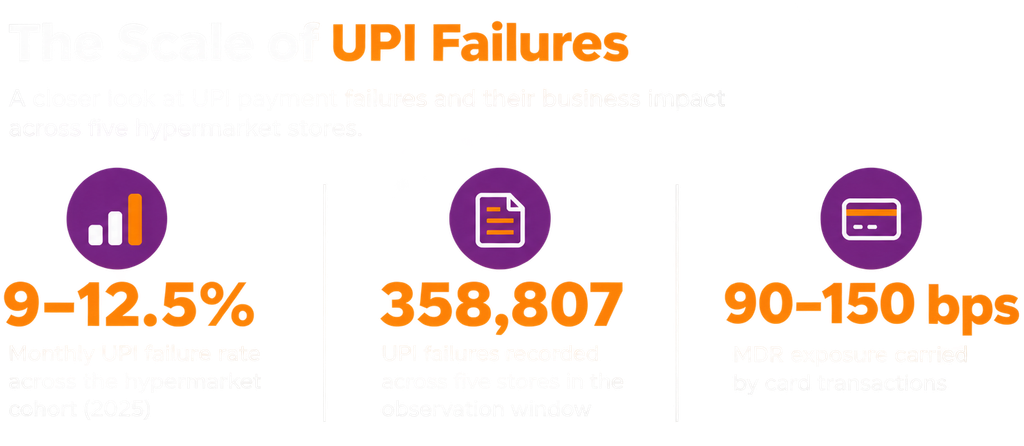
When a customer’s UPI payment fails, the next step is often to reach for a credit card. That shift keeps the sale moving, but it also moves the transaction from a zero-cost UPI rail to a card transaction that carries Merchant Discount Rate (MDR).
The issue was not simply that UPI transactions were failing. The bigger problem was what happened after they failed — and what that meant for merchant margins.
The Hidden Cost of UPI Failures
The cohort data showed a clear pattern in customer behaviour: for every 100 UPI failures, around 10 resulted in a card transaction within 90 seconds at the same checkout counter. The customer did not abandon the purchase — they simply changed the payment method, and the merchant absorbed the resulting MDR cost.
Estimated Margin Leakage
Based on an average transaction value of ₹3,000, switching approximately 300,000 transactions from a zero-cost UPI rail to an average 1% MDR card transaction over 12 months could result in around ₹90 lakh in margin leakage. At a 100-store scale, the same scenario could translate to approximately ₹18 crore in annual margin impact.
The numbers made the business problem clear: improving UPI reliability was not only about customer experience — it was also about protecting margin.
02 — Why the Existing Approach Was Not Enough
Enterprise retailers were largely dependent on reactive measures when a UPI payment failed. Store staff had to manually switch the UPI acquirer through the EDC terminal and ask the customer to try again, or let the customer complete the transaction using a credit card. Neither approach solved the problem at its source.
Manual switching was reactive. It happened only after the UPI transaction had already failed — and by that point, the customer had already seen the failure and could have moved to a card.
OPTION A — Try UPI again through manual intervention: Requires additional effort from store staff and depends on the customer attempting the transaction again.
OPTION B — Accept the card transaction: The sale goes through, but the merchant absorbs the associated MDR cost.
The Real Challenge: moving from reacting to UPI failures to preventing them from reaching the checkout counter in the first place.
Why Pre-Emptive Routing Matters
UPI Dynamic QR payments give merchants a manual rerouting option through the EDC terminal. However, this intervention is reactive. The store team needs to identify an issue and manually switch the UPI acquirer, usually after a transaction has already failed.
A pre-emptive approach works differently. Instead of waiting for a failed transaction and then switching the acquirer, the platform continuously monitors acquirer performance and identifies abnormal behaviour. It can then route the next UPI Dynamic QR transaction through a healthier acquirer before the customer attempts the payment.
This is where innoviti unipay’s UPI Acquirer Backup Platform changes the approach. It moves acquirer management from manual, post-failure intervention to automated, pre-emptive routing.
03 — The innoviti unipay Solution
India’s first AI-driven, pre-emptive acquirer-backup application designed specifically for in-store UPI Dynamic QR in organized retail.
Innoviti addressed this challenge with its UPI Acquirer Backup Platform, an AI-driven solution that automatically moves new UPI Dynamic QR traffic to a healthier acquirer when the primary acquirer begins showing signs of deterioration — before the customer ever encounters a failure.
● No merchant-side integration required
● No manual store-team intervention
● Reconciliation unaffected
How the Platform Works
The platform uses AI and unsupervised learning to understand the normal behaviour of each connected acquirer, then acts continuously to protect the payment flow.
1. Monitor acquirer behaviour — The platform continuously observes the live behaviour of connected acquirers and compares performance with their own historical response patterns.
2. Identify abnormal behaviour — When an acquirer begins to move away from its normal performance pattern, the system identifies the deviation in real time.
3. Reroute new UPI Dynamic QR traffic — New QR generations are directed to a healthier acquirer before customers begin experiencing failures.
4. Revalidate the primary acquirer — The system continuously monitors recovery and revalidates the primary acquirer every 30 minutes.
This allows the payment environment to respond dynamically — without requiring store staff to monitor acquirer performance manually.
04 — From Reactive Switching to Pre-Emptive Protection
Results from the one-month test across five stores.
| METRIC | RESULT | WHAT IT MEANS |
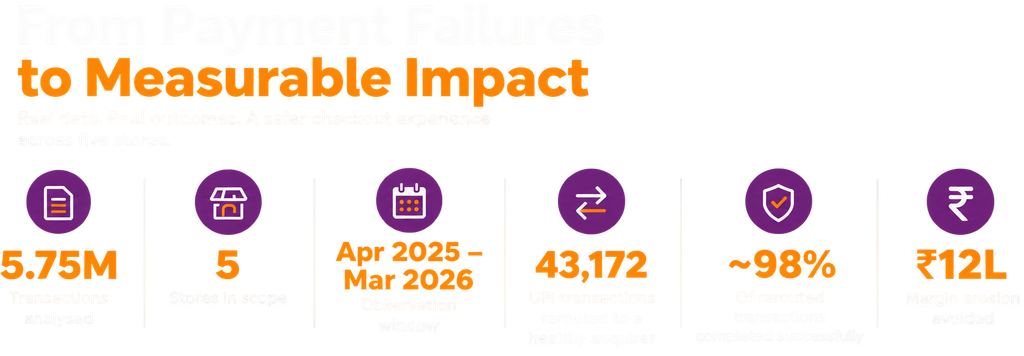
| UPI transactions intercepted & rerouted | 43,172 | Transactions at risk were identified and moved to a healthy acquirer before failure reached the customer. |
| Successful completion on healthy acquirer | ~98% | Of the ~44,000 intercepted transactions, nearly all completed successfully through the rerouted acquirer. |
| Estimated margin leakage avoided | ₹12 lakh | Using ~40,000 avoided card migrations, ₹3,000 average transaction value, and a 1% MDR assumption (five-store test). |
The figure of 40,000 avoided card migrations is an approximation used to simplify the savings calculation.
What the Results Could Mean at Scale
The five-store test demonstrated the potential of pre-emptive acquirer routing to reduce payment-related margin leakage. Based on the case study’s scaling model, projected savings at a 100-store scale could reach:
₹21.66 Lacs Projected savings / month at 100-store scale
₹2.6 Cr Annualized projection at 100-store scale
These figures represent projected savings based on scaling the test results — not savings already realised across 100 stores.
Lower Payment Processing Costs
Beyond reducing UPI failures and limiting customer migration to cards, Innoviti’s deployment data show that the platform can reduce digital payment processing costs by up to 6%. For large organized retailers, even a small improvement in payment economics can have a meaningful impact when applied across a high-volume transaction base.
05 — Minimal Operational Change, Measurable Business Impact
One of the key advantages of the solution is that the merchant does not need to change how store teams operate. The routing intelligence operates within the acquiring environment while the checkout experience remains familiar to the merchant and customer.
● No manual acquirer switching
● No merchant-side operational intervention
● No impact on reconciliation
● No additional action required from the customer
The Case Demonstrates Three Outcomes at Once
Better customer experience — Fewer UPI failures mean fewer payment interruptions at the checkout counter.
Lower payment costs — Keeping more transactions on the intended UPI rail reduces migration to higher-cost card transactions.
Less operational effort — Store teams no longer need to manually switch acquirers after every failure.
From recovery to prevention — The platform addresses the problem earlier in the payment journey — before it becomes a customer-facing failure.
The Takeaway
UPI has become a critical payment method for Indian retail. However, for large merchants, simply accepting UPI is not enough. In the five-store data, innoviti unipay’s UPI Acquirer Backup Platform intercepted 43,172 UPI transactions and rerouted them to a healthy acquirer, with approximately 98% completing successfully. A better UPI experience is not only about fewer failed payments: it can also mean lower payment costs, less operational intervention, and better protection of merchant margins.