
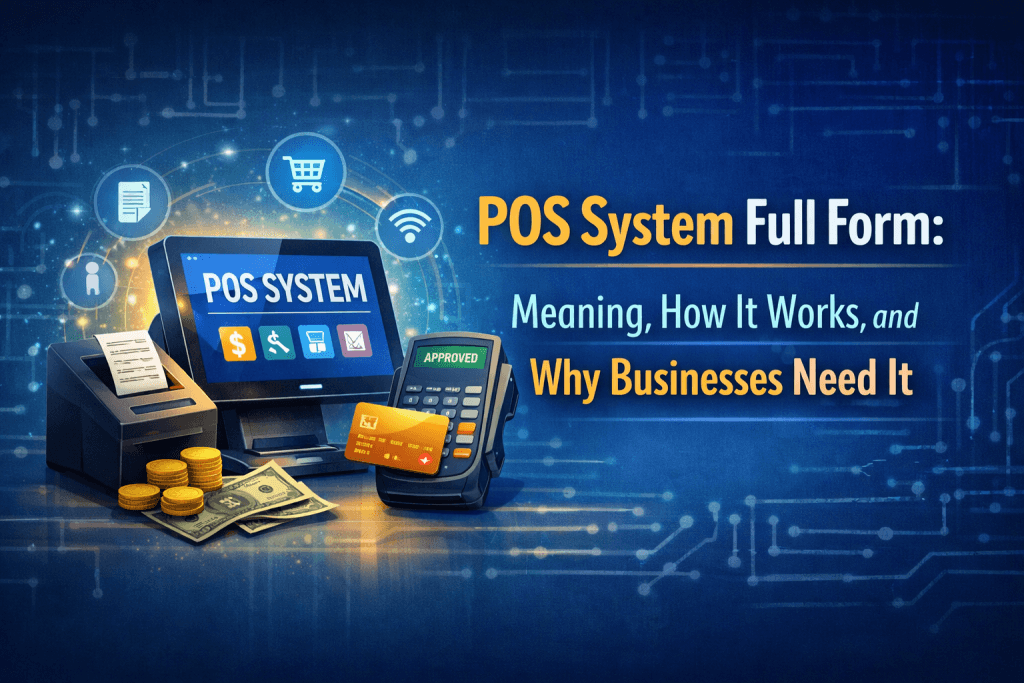
The POS system full form is Point of Sale. It refers to the place where a transaction between a business and a customer is completed. In today’s digital commerce environment, POS systems have evolved far beyond traditional billing machines. Modern POS technology enables businesses to process card payments, accept UPI transactions, manage inventory, and track sales in real time.
For retail chains, enterprise merchants, SMBs, and mobile dealers, POS systems play a critical role in simplifying payment processing and improving operational efficiency. With the rapid adoption of digital payments in India, businesses need advanced POS infrastructure to deliver seamless checkout experiences.
Companies like Innoviti’s digital payment platform help merchants adopt advanced POS payment solutions that integrate payment acceptance, analytics, and financial automation into one unified system.
The POS system full form is Point of Sale. It represents the physical or digital location where customers complete a payment transaction when purchasing goods or services.
Traditionally, POS systems were simple billing counters used to calculate totals and print receipts. Today, they have evolved into powerful digital payment platforms capable of handling multiple payment types.
A modern POS system typically includes:
Retailers increasingly rely on advanced POS payment solutions to manage both payments and store operations.
For a deeper explanation of POS systems and their retail applications, merchants can explore this guide on POS system full form and how it works.
Understanding the POS system full form is important because POS technology sits at the heart of modern commerce.
Every time a customer pays using a card, UPI, or digital wallet, the transaction is processed through a POS system.
Businesses benefit from POS systems because they enable:
Retail businesses also use POS systems to integrate with broader digital payment infrastructure that supports multiple payment methods.
Innoviti’s merchant payment platform enables businesses to streamline payment acceptance and manage transactions efficiently across locations.
A modern POS system includes multiple features designed to simplify retail operations and digital payments.
POS systems allow merchants to accept various payment methods including:
This flexibility helps businesses serve more customers.
POS systems process transactions instantly, improving checkout speed and customer satisfaction.
Advanced POS systems help retailers monitor inventory levels and automatically update stock when a product is sold.
Businesses can analyze transaction data to understand:
Security features such as encryption and fraud detection ensure safe transactions.
Businesses must also remain aware of payment risks. Merchants can learn more about protecting their operations from payment fraud risks and prevention strategies.
Understanding the POS system full form also highlights why POS technology provides major advantages for businesses.
POS systems reduce waiting times at checkout counters by processing payments instantly.
Automated billing eliminates manual calculation errors.
POS systems record every transaction, making it easier for businesses to manage revenue and accounting.
Customers can pay using their preferred payment method, improving satisfaction and loyalty.
POS analytics help businesses identify best-selling products and optimize pricing strategies.
Many modern businesses combine POS systems with broader cashless payment systems to support a fully digital commerce environment.
To fully understand the POS system full form, it’s helpful to look at how POS transactions are processed.
The cashier enters the product into the POS system or scans its barcode.
The POS software calculates the total amount including taxes and discounts.
The customer selects a payment method such as:
The POS system communicates with payment networks and banks to authorize the payment.
Once the bank approves the transaction, the POS system confirms the payment and generates a receipt.
Modern POS technology integrates with broader digital payment solutions for merchants to enable seamless multi-channel transactions.
The POS system full form becomes clearer when examining real-world applications.
Large retail stores rely on POS systems to manage thousands of transactions daily while maintaining accurate inventory records.
Enterprises with multiple branches use POS systems to track centralized sales data and customer purchasing behavior.
SMB merchants use POS machines to accept digital payments without investing in complex infrastructure.
Mobile dealers often use POS systems to enable card-based EMI payments for smartphones and electronic devices.
Businesses looking to offer flexible purchase options often combine POS systems with No Cost EMI payment solutions.
Businesses that do not adopt POS systems often face operational inefficiencies.
Manual billing takes longer and increases customer waiting time.
Customers may not be able to pay using digital payment methods.
Without POS systems, businesses struggle to maintain accurate sales records.
Manual processes increase the chances of billing mistakes.
Modern retailers increasingly adopt POS payment solutions to eliminate these operational challenges.
Innoviti provides advanced payment technology that enables businesses to deploy modern POS systems quickly and efficiently.
Through solutions like Innoviti Genie POS payment solutions, merchants can accept multiple payment methods while gaining access to advanced analytics and transaction management tools.
Unified Payment Acceptance
Businesses can accept cards, UPI, and digital wallet payments through one integrated platform.
Advanced Merchant Tools
Innoviti solutions provide real-time insights into transactions and payment performance.
Retail-Focused Innovation
Innoviti specializes in payment infrastructure designed specifically for retail businesses and enterprise merchants.
The company has also received regulatory approval from the Reserve Bank of India, reinforcing its credibility as a trusted payment technology provider. Learn more in this RBI authorization announcement.
India’s digital payments ecosystem is expanding rapidly due to fintech innovation and widespread smartphone adoption.
UPI has become the backbone of India’s digital payment infrastructure, enabling instant bank-to-bank transactions.
Fintech companies are increasingly adopting artificial intelligence to improve fraud detection and payment routing.
Innoviti has already introduced AI-powered payment innovations, strengthening merchant payment infrastructure.
Businesses are increasingly using automated tools for:
As digital payments continue to grow, POS systems will remain a critical component of modern commerce.
The POS system full form is Point of Sale. It refers to the location and technology used by businesses to complete transactions when customers purchase goods or services.
Key elements of a POS system include:
The POS system full form is Point of Sale. It refers to the location and technology used by businesses to process customer transactions and complete purchases.
A POS system processes transactions by calculating the purchase total, sending payment requests to banks or payment networks, and confirming the payment. It also records the transaction for accounting and reporting.
Businesses use POS systems to process digital payments, manage inventory, and track sales efficiently. These systems improve checkout speed and reduce operational errors.
Modern POS systems accept multiple payment methods including credit cards, debit cards, UPI, digital wallets, and contactless payments.
Yes, POS systems use encryption and secure payment protocols to protect transaction data. Many systems also include fraud detection and compliance with financial security standards.
Innoviti provides advanced POS payment solutions designed for retail businesses and enterprise merchants. These solutions help businesses accept multiple payment methods while improving transaction efficiency.
Understanding the POS system full form is essential for businesses navigating today’s digital commerce landscape. POS systems serve as the backbone of modern payment infrastructure, enabling merchants to process transactions quickly, securely, and efficiently.
For retail chains, enterprise merchants, SMB businesses, and mobile dealers, POS technology provides critical advantages including faster checkout, improved financial tracking, and seamless multi-payment acceptance.
As India continues to move toward a cashless economy driven by UPI, fintech innovation, and real-time settlements, POS systems will play an even greater role in enabling efficient digital transactions.
With advanced fintech solutions and merchant-focused payment infrastructure, Innoviti empowers businesses to modernize their payment operations and stay competitive in the rapidly evolving digital payments ecosystem.