
UPI Payment Gateway Charges: Complete Guide for Businesses in India
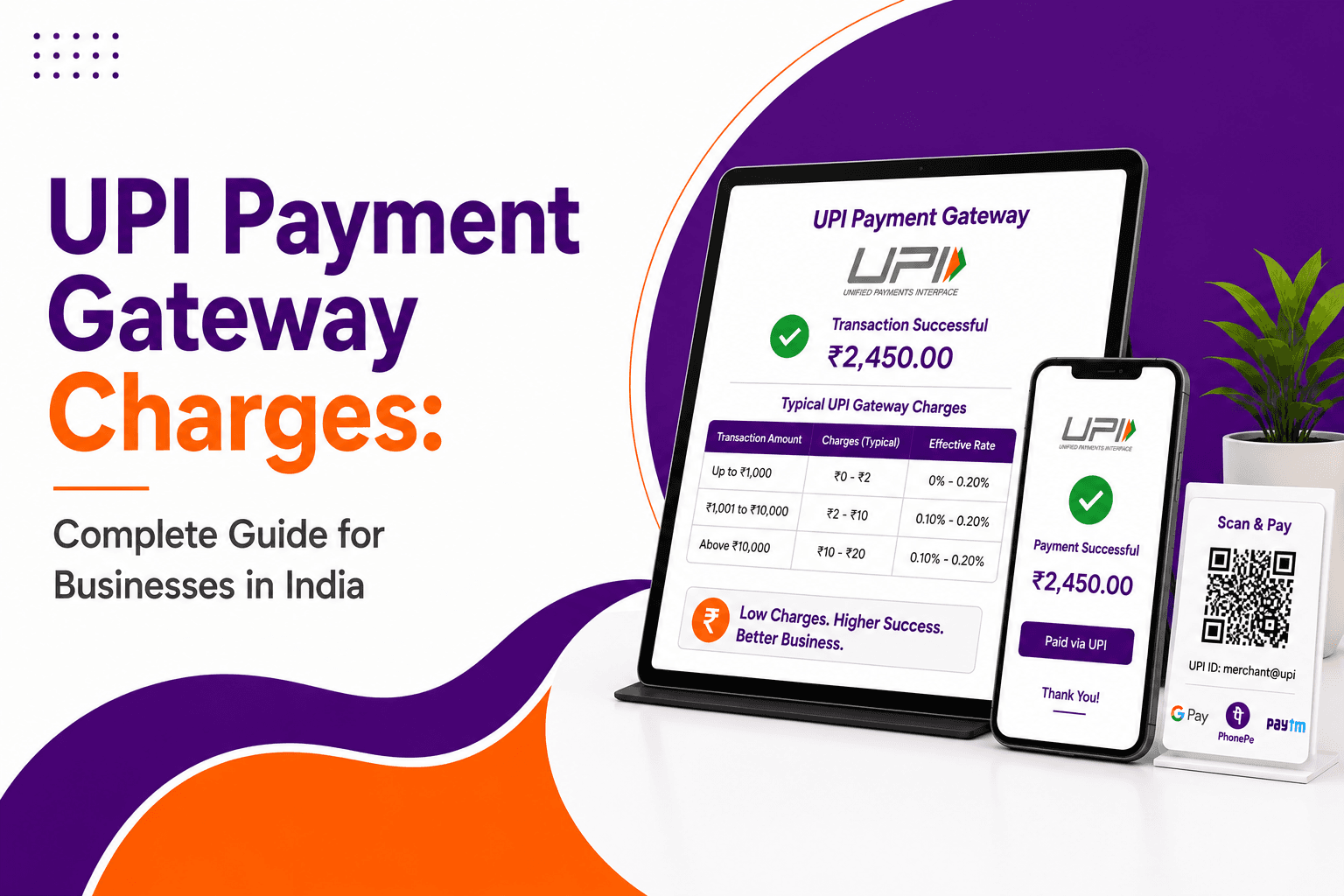
UPI carries zero MDR for bank-account transactions up to ₹2,000. From 15 October 2026, a 0.4% MDR applies to many person-to-merchant UPI payments above ₹2,000, capped at ₹300. Payment gateways charge a separate platform fee on top of MDR.
Understanding UPI payment gateway charges helps businesses plan their payment costs accurately and choose the right provider. This guide covers the cost components, how UPI and payment gateways differ, and how businesses can accept UPI payments securely in India. For the wider picture on the new framework, read our UPI MDR 2026 guide and the UPI transaction fees and charges explainer.
Table of contents
- What Are UPI Payment Gateway Charges?
- Cost Components of UPI Payment Gateway Charges
- Difference Between UPI and Payment Gateway
- UPI Business Account Charges
- How to Accept UPI Payments Securely
- Factors That Influence the Charges
- Common Misconceptions
- How Innoviti Supports UPI Acceptance
- Quick Summary
- Frequently Asked Questions
- Conclusion
What Are UPI Payment Gateway Charges?
UPI payment gateway charges are the fees a business pays when it accepts UPI payments through a payment gateway or payment aggregator, rather than through a standalone QR code or UPI ID.
UPI MDR (merchant discount rate) is zero for transactions up to ₹2,000. Under the framework announced in September 2026, a 0.4% MDR applies to person-to-merchant (P2M) UPI payments above ₹2,000 from 15 October 2026. It is capped at ₹300 for payments of ₹75,000 and above. The payment gateway also charges its own platform fee.
Who pays less, or nothing
- Small merchants: those receiving up to ₹1 lakh a month through UPI QR codes pay no MDR. A merchant who goes above that for three months in a row moves to the P2M category.
- Specific sectors: categories such as railways, telecom, insurance and fuel pay a flat ₹5 per transaction above ₹2,000. Capital market payments carry 0.02%, capped at ₹300.
- Not covered: person-to-person UPI payments and UPI AutoPay mandates carry no MDR under this framework.
- No pass-through: merchants cannot recover MDR by adding a charge for the customer.
UPI payments made with RuPay credit cards are credit products and follow separate credit-card pricing rules, so this MDR does not apply to them in the same way. Ask your acquirer or gateway which rate applies to you.
Source: Department of Financial Services, FAQs on MDR on select UPI (P2M) transactions.
Cost Components of UPI Payment Gateway Charges
UPI payment gateway charges have two main parts: MDR, which goes to the banks and the wider UPI ecosystem, and the platform fee, which goes to the payment gateway provider.
| Component | UPI (bank account) | UPI (RuPay credit card) |
|---|---|---|
| MDR (to banks and the UPI ecosystem) | Zero up to ₹2,000. 0.4% on P2M above ₹2,000, capped at ₹300, from 15 Oct 2026 | Follows credit-card pricing rules; varies by acquirer |
| Platform fee (to the payment gateway) | Set by your provider | Set by your provider; may differ from bank-account UPI |
| GST on platform fee | 18% of the platform fee | 18% of the platform fee |
| Setup fee | Some providers charge one; others charge nil | Same as bank-account UPI |
| Annual maintenance | Some providers charge one; others charge nil | Same as bank-account UPI |
Example. A ₹1,000 UPI payment from a bank account through a gateway with a 2% platform fee (an example rate; yours is set by your provider): ₹20 platform fee plus ₹3.60 GST. No MDR applies because the amount is under ₹2,000.
On a ₹5,000 payment the 0.4% MDR adds ₹20, so the total is ₹20 MDR + ₹100 platform fee + ₹18 GST = ₹138.
Difference Between UPI and Payment Gateway
UPI is a payment method. A payment gateway is the technology that processes payments. They do different jobs and work together in most business setups. For a deeper comparison, see payment aggregator vs payment gateway.
| Feature | UPI | Payment gateway |
|---|---|---|
| What it does | Real-time bank-to-bank transfer via VPA or QR code | Routes card, UPI, net banking and wallet payments through one integration |
| Payment methods | Bank-account transfers, plus credit cards linked to UPI | Cards, UPI, net banking, wallets, EMI and international payments |
| Settlement speed | Real time to the merchant’s bank account | Depends on the provider; commonly T+1 to T+3 business days |
| MDR | Zero up to ₹2,000; 0.4% above for P2M from 15 Oct 2026; exemptions apply | Varies by payment method and provider |
| Setup needed | A QR code or UPI ID; no technical integration | API or plugin integration with your website or app |
| Best for | Small and medium merchants, quick retail checkout | Online businesses, multi-channel retailers, high-value and international payments |
Most businesses use both. A gateway accepts UPI as one of several methods, so customers can choose UPI, card, net banking or wallet at checkout. Our guide to the UPI payment gateway in India explains how that works.
UPI Business Account Charges: What Businesses Actually Pay
A business can accept UPI through a direct UPI business account with its bank, or through a payment gateway. The charges differ.
Direct UPI business account (through a bank)
- Zero MDR on bank-account UPI up to ₹2,000, and none for small merchants receiving up to ₹1 lakh a month through UPI QR codes. A 0.4% MDR applies above ₹2,000 for P2M payments.
- No platform fee if you use the bank’s own UPI ID or QR code.
- Limited reporting and reconciliation.
- UPI only, with no multi-method acceptance.
UPI through a payment gateway
- The same MDR as a direct account.
- A platform fee set by the gateway provider.
- Full reporting, analytics and automated reconciliation.
- UPI, cards, net banking, wallets and EMI through one integration.
For small merchants with low volumes, a direct UPI business account may be enough, and our UPI QR code guide for retailers shows how to set one up. For businesses that need multi-method acceptance, reporting and reconciliation, a payment gateway is the practical choice despite the platform fee.
How Do Businesses Accept UPI Payments Securely in India?
Secure UPI acceptance needs the right infrastructure, whether through a direct bank integration or a payment gateway. These are the key steps.
- Choose your UPI acceptance methodPick a direct UPI business account for UPI-only acceptance, or a payment gateway for multi-method acceptance that includes UPI.
- Register with an RBI-authorised payment aggregatorIf you use a gateway, choose one with RBI authorisation as a Payment Aggregator, so payments run through a regulated platform. Read what a payment aggregator is before you decide.
- Set up UPI acceptanceFor in-store payments, display a UPI QR code at the billing counter. For online payments, integrate the gateway’s API or plugin into your website or app.
- Verify security complianceConfirm your provider is PCI DSS compliant and supports encryption, tokenisation and fraud monitoring. These protect your business and your customers.
- Configure settlement and reportingSet your settlement schedule (instant, T+1 or T+2) and build reporting dashboards to track UPI next to other payment methods. See how instant settlement and automated payment reconciliation work.
Factors That Influence UPI Payment Gateway Charges
- Transaction volume: high-volume merchants may negotiate lower platform fees.
- Business category: e-commerce, retail, education and healthcare may get different pricing.
- Integration complexity: custom API integrations or omnichannel setups may need extra infrastructure support.
- Payment method mix: businesses that take more card payments pay a higher blended cost than those mostly on UPI. See POS credit card fees for the card side.
- Settlement speed: instant settlement may cost more than standard T+1 or T+2.
For a full view of what gateways charge across methods, read our guide to payment gateway charges in India.
UPI Payment Service Charges: Common Misconceptions
- “UPI is completely free for businesses.” UPI MDR is zero up to ₹2,000, and small merchants receiving up to ₹1 lakh a month through UPI QR codes pay none. Above ₹2,000, a 0.4% MDR applies for P2M payments from 15 October 2026, and gateways charge their own platform fee.
- “All UPI payment providers charge the same.” Platform fees, setup charges and annual maintenance vary by provider. Some charge nothing for setup and maintenance; others charge a fee.
- “UPI replaces a payment gateway.” UPI is one payment method. A gateway accepts UPI alongside cards, wallets, net banking and EMI through a single integration.
How Innoviti Supports UPI Payment Acceptance
Innoviti is an RBI-authorised Payment Aggregator for online and in-store payments under the Payment and Settlement Systems Act, 2007. The platform supports UPI, card and EMI payments through one system. Learn how a UPI-first checkout fits in.
Innoviti UniPay
Enterprise POS payment and reconciliation platform. Accepts UPI, card and EMI in store, and reconciles cash, UPI and card payments for large retailers.
Explore UniPay →Innoviti Genie
Sales acceleration platform for dealers. Card settlements in under 15 seconds and extra dealer margins of up to 1%.
Explore Genie →Innoviti Link
Payment collection app for businesses. Accepts card, UPI and EMI payments through payment links, with instant settlement. No POS machine or website needed.
Explore Link →Innoviti holds PCI DSS, P2PE and PCI PIN certifications.
UPI Payment Gateway Charges: Quick Summary
UPI payment gateway charges are MDR plus the gateway’s platform fee. MDR is zero up to ₹2,000. From 15 October 2026, 0.4% applies to many P2M payments above ₹2,000, capped at ₹300, with exemptions for small merchants and certain sectors.
The platform fee is set by your gateway provider, with 18% GST on top, and applies in addition to any MDR.
A business using a direct bank QR code pays no platform fee. A business using a payment gateway pays the fee in return for multi-method acceptance, reporting and reconciliation.
Frequently Asked Questions
What are UPI payment gateway charges?
UPI payment gateway charges are the fees businesses pay when accepting UPI payments through a payment gateway. UPI MDR is zero for transactions up to ₹2,000. From 15 October 2026, a 0.4% MDR applies to many person-to-merchant payments above ₹2,000, capped at ₹300 for payments of ₹75,000 and above. The gateway’s platform fee is separate.
What are UPI business account charges?
A direct UPI business account through a bank has no platform fee. MDR is zero up to ₹2,000, and small merchants receiving up to ₹1 lakh a month through UPI QR codes pay no MDR. Above that, a 0.4% MDR applies to person-to-merchant payments above ₹2,000 from 15 October 2026.
What is the difference between UPI and a payment gateway?
UPI is a real-time bank-to-bank payment method. A payment gateway is the technology that processes multiple payment types (card, UPI, net banking, wallet) through one integration. A gateway can accept UPI as one of its payment options.
Are UPI payment service charges the same for all businesses?
No. Charges vary by payment gateway provider, transaction volume, business category and the features included. Compare platform fees, setup charges and settlement terms across providers before you choose.
How do businesses accept UPI payments securely in India?
Register with an RBI-authorised payment aggregator, set up a UPI QR code or gateway integration, and make sure your provider is PCI DSS compliant with encryption and fraud monitoring.
Does Innoviti support UPI payment acceptance?
Yes. Innoviti is an RBI-authorised Payment Aggregator supporting UPI, card and EMI payments. Its products, UniPay, Genie and Link, give enterprise retailers, dealers and merchants a single way to accept UPI.
Conclusion
UPI payment gateway charges include both MDR and platform fees. UPI MDR stays zero up to ₹2,000, but the 0.4% MDR on higher-value P2M payments from 15 October 2026 and the gateway platform fee are the costs businesses need to weigh.
Choosing the right UPI payment gateway means comparing platform fees, settlement speed, reporting quality and multi-method support across providers.
Innoviti provides one payment platform for UPI, card and EMI acceptance, helping businesses manage payment costs with clear settlement reporting.
MDR on person-to-merchant UPI payments
What a merchant pays on a ₹5,000 payment through a gateway (example)
Total: ₹138 on ₹5,000
Exempt or charged differently
Platform fee is set by your payment gateway and varies by provider. Source: Department of Financial Services FAQs on MDR on select UPI (P2M) transactions.
Collect card, UPI and EMI payments without a POS machine or website.
See how Innoviti Link works