
What Is a Payment Aggregator in India? A Complete Guide
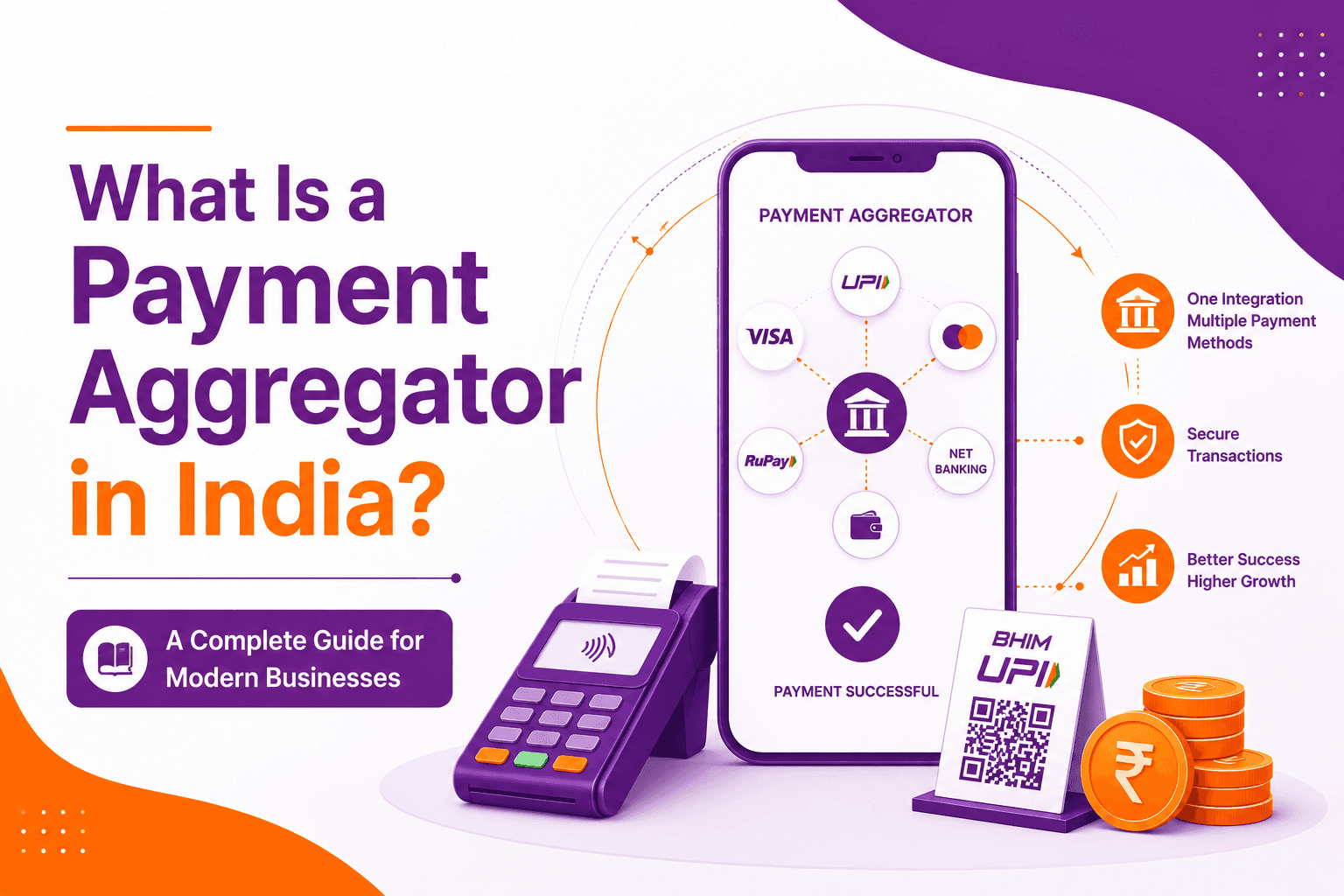
A payment aggregator is a service provider that enables businesses to accept digital payments through a single integration. It handles payment collection, processing, and settlement on behalf of merchants.
In India, payment aggregators are regulated by the Reserve Bank of India (RBI) under the Regulation of Payment Aggregators Directions, 2025, issued under the Payment and Settlement Systems Act, 2007.
This guide explains what a payment aggregator does, how it differs from a payment gateway, and what Indian businesses should consider when choosing one.
Table of Contents
- Payment Aggregator Meaning
- Payment Aggregator vs Payment Gateway
- RBI Guidelines for Payment Aggregators in India
- Payment Aggregator Examples in India
- Payment Aggregator Business Model
- Key Features of Payment Aggregators
- How Payment Aggregators Work
- Challenges Businesses Face with Payment Aggregators
- How Innoviti Works as a Payment Aggregator in India
- What Is a Payment Aggregator in India? (Quick Answer)
- Frequently Asked Questions
- Conclusion
Payment Aggregator Meaning
A payment aggregator (PA) is an entity that enables merchants to accept payments from customers using multiple payment methods without needing a direct relationship with each bank or payment network.
The PA pools funds collected from customers in an escrow account and settles them to the merchant’s bank account after deducting processing fees.
Payment aggregators handle the technical integration, compliance requirements, and fund settlement. This allows businesses to start accepting payments quickly without setting up individual merchant accounts with multiple banks.
How Payment Aggregators Support Businesses
- Single integration: Merchants connect once to accept card, UPI, net banking, wallet, and EMI payments.
- Faster onboarding: The PA handles KYC, compliance checks, and bank partnerships, so merchants can start accepting payments within days.
- Fund management: Payments are collected in a regulated escrow account and settled to the merchant on a fixed schedule.
- Compliance: The PA manages regulatory requirements including PCI DSS, data security, and RBI reporting.
Payment Aggregator vs Payment Gateway
A payment aggregator and a payment gateway serve different roles in the payment process. A gateway only routes transaction data. An aggregator handles the full payment lifecycle.
| Feature | Payment Aggregator | Payment Gateway |
|---|---|---|
| Primary role | Collects, pools, and settles funds on behalf of merchants | Routes transaction data between merchant, bank, and card network |
| Merchant onboarding | Full onboarding including KYC and compliance checks | Limited or none; merchant needs a separate bank merchant account |
| Fund handling | Holds funds in an escrow account before settling to merchant | Does not hold funds; only passes transaction information |
| Settlement | Manages settlement to merchant’s bank account | No direct settlement role |
| RBI regulation | Must hold RBI authorisation under PA guidelines | Not directly regulated by RBI (follows baseline tech standards) |
| Best suited for | Businesses wanting end-to-end payment management | Businesses with existing bank merchant accounts needing transaction routing. |
Many businesses use both. The payment gateway handles the technical routing of transactions, while the payment aggregator manages the commercial relationship, fund pooling, and settlement.
RBI Guidelines for Payment Aggregators in India
The RBI issued the Regulation of Payment Aggregators Directions on 15 September 2025, consolidating earlier guidelines from March 2020. These directions were issued under the Payment and Settlement Systems Act, 2007.
Key RBI Requirements for Payment Aggregators
- Authorisation: Every payment aggregator must obtain RBI authorisation to operate. Operating without it is a violation of the PSS Act.
- Net worth: PAs must maintain a minimum net worth of Rs 15 crore at the time of application and Rs 25 crore by the end of their third financial year of receiving authorisation.
- Escrow account: All merchant funds must be held in an escrow account with a scheduled commercial bank. Only prescribed debits and credits are allowed.
- Merchant KYC: PAs must conduct background checks on all merchants they onboard, including verification of business registration and identity.
- Data security: PAs must comply with PCI DSS standards, maintain a board-approved cybersecurity policy, and report incidents to CERT-In.
- Annual audit: A System Audit Report must be submitted to the RBI within two months after each financial year.
Payment Aggregator Examples in India
Several companies operate as RBI-authorised payment aggregators in India. Each serves different business segments and offers varying features.
- Innoviti: RBI-authorised PA for online and in-store payments. Processes over Rs 80,000 crore annually across 2,000+ cities and 50,000+ merchants.
- Razorpay: Online payment aggregator popular with startups and e-commerce businesses. Supports cards, UPI, net banking, and wallets.
- PayU: Online PA serving large enterprises and mid-market businesses. Received final RBI authorisation in 2025.
- Cashfree Payments: PA focused on payouts, payment collection, and banking APIs for businesses.
- CCAvenue (Infibeam Avenues): One of India’s oldest online payment aggregators, serving merchants since 2001.
The RBI maintains an updated list of payment aggregators in India on its website. Businesses should verify a PA’s authorisation status on the RBI list before partnering with any provider.
Payment Aggregator Business Model
A payment aggregator earns revenue primarily through the fees it charges merchants on each transaction. This is typically a percentage of the transaction amount, sometimes with a fixed component.
Revenue Sources
- Transaction fees: A percentage (typically 1.5% to 3% for credit cards) charged on each payment processed through the platform.
- Setup and annual fees: Some PAs charge merchants a one-time setup fee or annual maintenance fee for platform access.
- Value-added services: Revenue from additional services like payment links, subscription billing, invoicing, analytics dashboards, and instant settlements.
Cost Structure
The PA’s costs include interchange fees paid to issuing banks, network fees to card schemes, technology infrastructure, compliance and audit costs, and customer support.
The margin between what the PA charges the merchant and what it pays to banks and networks is the PA’s gross profit on each transaction.
Key Features of Payment Aggregators
- Multi-channel payment acceptance: Support for cards (credit and debit), UPI, net banking, wallets, and EMI through a single integration.
- UPI integration: UPI collect, UPI intent, and QR-based payment flows for both online and in-store transactions.
- Secure payment processing: PCI DSS compliance, data encryption, tokenisation, and fraud monitoring to protect transaction data.
- Automated settlement: Funds are automatically settled to the merchant’s bank account on a defined schedule, with detailed settlement reports.
- Reporting and analytics: Dashboards showing transaction volume, success rates, refund status, and settlement details.
- Merchant onboarding: Digital KYC, document verification, and compliance checks handled by the PA, reducing the merchant’s administrative burden.
How Payment Aggregators Work
Here is a step-by-step view of how a payment aggregator processes a transaction from initiation to settlement:
| Step | What Happens |
|---|---|
| 1. Payment initiation | Customer selects a payment method (card, UPI, net banking, wallet, or EMI) at checkout. |
| 2. Routing | The payment aggregator routes the transaction to the relevant bank or payment network. |
| 3. Authorisation | The issuing bank or UPI app verifies the transaction and approves or declines it. |
| 4. Collection | The payment aggregator collects the approved funds into a pooled escrow account. |
| 5. Settlement | Funds are settled to the merchant’s bank account, minus processing fees, on the agreed schedule (typically T+1 or T+2). |
This process applies to both online and in-store payments. For in-store transactions, the POS terminal replaces the online checkout page in step 1.
Challenges Businesses Face with Payment Aggregators
- Payment failures: Transaction declines due to bank timeouts, network errors, or insufficient funds reduce conversion rates and customer satisfaction.
- Settlement delays: Standard settlement cycles of T+1 or T+2 can create cash flow gaps, especially for businesses with thin margins.
- Fee transparency: Some PAs bundle interchange, network, and processing fees into a single rate, making it difficult to identify cost components.
- Fraud risk: Online payment fraud, chargebacks, and identity theft require ongoing monitoring and prevention measures.
- Regulatory compliance: PAs must stay current with RBI guidelines, PCI DSS requirements, and data localisation rules. Merchants should verify their PA’s compliance status.
How Innoviti Works as a Payment Aggregator in India
Innoviti is an RBI-authorised Payment Aggregator for online and in-store payments under the Payment and Settlement Systems Act, 2007. The company specialises in merchant payment infrastructure.
- Innoviti UniPay: Enterprise POS payment and revenue assurance platform for large retailers. Handles card, UPI, and cash reconciliation from a single dashboard with automated settlement tracking.
- Innoviti Genie: Sales acceleration platform for dealer networks. Card and UPI settlements in under 15 seconds with dealer margin programmes of up to 1%.
- Innoviti Link: Payment collection app for businesses. Accepts card, UPI, and EMI payments via payment links with instant settlement. No POS machine or website needed.
Innoviti holds PCI DSS, P2PE, and PCI PIN certifications. The platform processes over Rs 80,000 crore annually across 2,000+ cities and 50,000+ merchants.
What Is a Payment Aggregator in India? (Quick Answer)
A payment aggregator in India is an RBI-regulated entity that enables businesses to accept digital payments through a single platform. It collects payments from customers, pools them in an escrow account, and settles them to the merchant’s bank account.
Payment aggregators handle merchant onboarding, payment processing, compliance, and settlement. They support multiple payment methods including cards, UPI, net banking, wallets, and EMI.
Under the RBI’s Regulation of Payment Aggregators Directions, 2025, all PAs must hold authorisation, maintain a net worth of Rs 15 crore at application (Rs 25 crore by the third year), and follow prescribed security and reporting standards.
Frequently Asked Questions
What is a payment aggregator in India?
A payment aggregator is an RBI-regulated service provider that enables businesses to accept multiple payment methods through one integration. It handles payment collection, processing, and settlement on behalf of merchants under the Payment and Settlement Systems Act, 2007.
What is the difference between a payment aggregator and a payment gateway?
A payment gateway routes transaction data between the merchant, bank, and card network. A payment aggregator does that and also handles merchant onboarding, fund pooling in an escrow account, compliance management, and settlement to the merchant’s bank account.
Are payment aggregators regulated by the RBI?
Yes. The RBI issued the Regulation of Payment Aggregators Directions on 15 September 2025. Every PA must obtain RBI authorisation and maintain a net worth of Rs 15 crore at application (Rs 25 crore by the third year). PAs must also hold merchant funds in an escrow account and comply with PCI DSS and data security standards.
What is a payment aggregator business model?
Payment aggregators earn revenue by charging merchants a fee on each transaction processed through their platform. This fee is typically a percentage of the transaction amount. Additional revenue comes from setup fees, annual charges, and value-added services like analytics and instant settlement.
What are some payment aggregator examples in India?
RBI-authorised payment aggregators in India include Innoviti, Razorpay, PayU, Cashfree Payments, and CCAvenue. Each serves different business segments. The RBI maintains an updated list of authorised PAs on its website.
How can businesses choose a payment aggregator in India?
Businesses should check RBI authorisation status, evaluate transaction success rates, compare fee structures, review settlement timelines, and assess the PA’s security certifications (PCI DSS, P2PE) and customer support quality.
Conclusion
Payment aggregators play a central role in India’s digital payment infrastructure. They simplify payment acceptance for businesses by handling collection, processing, compliance, and settlement through one platform.
With RBI regulation now firmly in place, businesses benefit from working with authorised payment aggregators that meet prescribed security and financial standards.
Innoviti operates as an RBI-authorised Payment Aggregator serving enterprise retailers, dealer networks, and merchants with unified payment acceptance across card, UPI, and EMI channels.