
What Is a Digital Payment System? A Complete Guide for Businesses in India
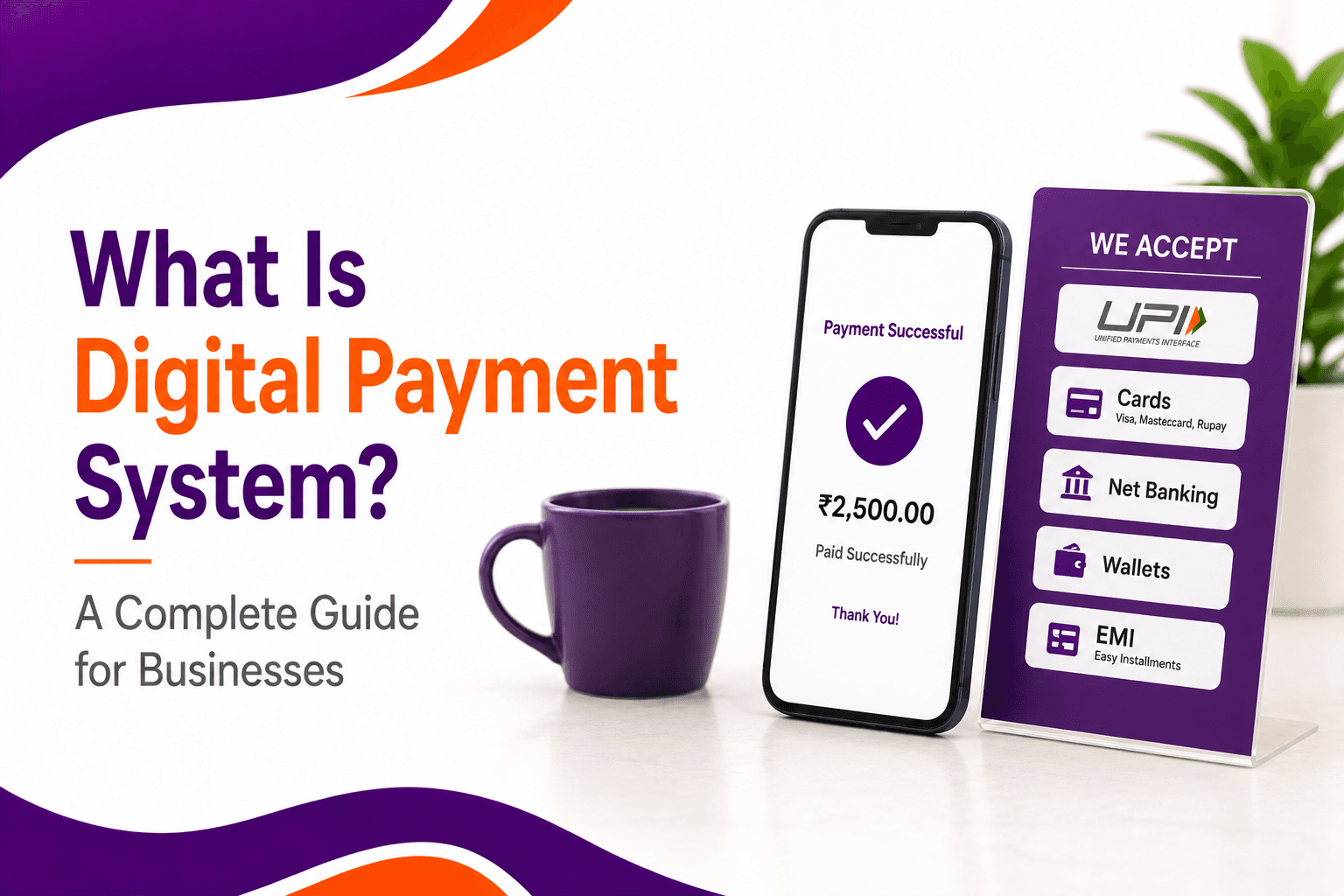
A digital payment system is a technology platform that enables electronic transactions between customers, merchants, and financial institutions without the use of physical cash.
In India, digital payment adoption has grown rapidly. UPI alone processed 241.62 billion transactions worth approximately Rs 314 lakh crore in FY26, a 30% increase in volume over FY25.
This guide explains what a digital payment system is, the different modes of digital payment available in India, and how businesses can use digital payment solutions to accept and manage payments.
Key takeaways
- A digital payment system moves money electronically between customer, merchant and bank, with no cash, cheque or demand draft involved.
- It has four parts: payment gateway, payment aggregator, banking network and authentication system.
- India’s main modes are UPI, cards, net banking, wallets, AEPS and payment links. UPI carries over 83% of digital transaction volume.
- Businesses accept payments through POS terminals, an online gateway, payment links or a UPI QR code.
Table of Contents
- What Is Digital Payment?
- Modes of Digital Payment in India
- Features of Digital Payment Systems
- How a Digital Payment System Works
- Digital Payment System in India: Growth and Adoption
- Digital Payment Solutions for Businesses
- Challenges with Digital Payment Systems
- How Innoviti Supports Digital Payment Systems
- What Is a Digital Payment System? (Quick Answer)
- Frequently Asked Questions
- Conclusion
What Is Digital Payment?
Digital payment means any transaction where money moves electronically from the payer to the payee, without involving physical cash, cheques, or demand drafts.
A digital payment can happen through a POS terminal in a store, a payment gateway on a website, a UPI app on a smartphone, or a payment link sent via message.
The common thread across all these digital payment services is that the payment is processed electronically through banking or payment networks.
Components of a Digital Payment System
- Payment gateway: Routes transaction data between the merchant and the bank for authorisation.
- Payment aggregator: Manages merchant onboarding, payment collection, compliance, and settlement.
- Banking network: Processes the transaction through the issuing bank, acquiring bank, and card or UPI network.
- Authentication system: Verifies the payer’s identity through PIN, OTP, biometric, or UPI PIN.
Modes of Digital Payment in India
India’s digital payment infrastructure supports multiple modes. Each serves different transaction types and use cases. Here are the primary modes of digital payment:
| Mode | How It Works | Common Use Cases |
|---|---|---|
| UPI (Unified Payments Interface) | Instant bank-to-bank transfer via mobile app using UPI ID or QR code | Retail purchases, bill payments, peer-to-peer transfers, merchant payments |
| Credit and debit cards | Card data is routed through POS terminal or payment gateway to issuing bank for authorisation | In-store and online purchases, EMI transactions, recurring payments |
| Mobile wallets | Prepaid digital wallet loaded via bank account or card; payments made from wallet balance | Small-value transactions, transit, quick purchases |
| Net banking (NEFT/RTGS/IMPS) | Bank-to-bank transfer initiated through the bank’s online portal | Large-value transfers (RTGS), salary payments, B2B transactions, bill payments |
| AEPS (Aadhaar Enabled Payment System) | Uses Aadhaar number and biometric authentication for transactions at a micro-ATM | Cash withdrawal, balance enquiry, and fund transfer in rural and semi-urban areas |
| Payment links | Merchant sends a payment link via SMS, WhatsApp, or email; customer pays by clicking the link. | Remote payments, service businesses, freelancers, door-to-door collections |
UPI is the most widely used mode. It accounted for over 83% of all digital transaction volume in India in FY26. Card payments and net banking continue to serve high-value transactions and EMI-based purchases.
Features of Digital Payment Systems
- Multi-method acceptance: A single digital payment system can accept UPI, cards, net banking, wallets, and EMI through one integration.
- Real-time processing: Transactions are authorised and confirmed within seconds. UPI transactions settle instantly; card settlements typically follow T+1 or T+2 cycles.
- Security infrastructure: Encryption, tokenisation, PCI DSS compliance, and two-factor authentication protect transaction data and prevent fraud.
- Automated reconciliation: Digital payment platforms provide settlement reports, transaction logs, and automated matching of collections against orders.
- Payment links: Merchants can collect payments remotely by sending a link via SMS, WhatsApp, or email. No POS device or website needed.
- Analytics and reporting: Dashboards showing transaction volume, success rates, refund status, and revenue trends.
How a Digital Payment System Works
Digital Payment System in India: Growth and Adoption
India’s digital payment ecosystem has grown significantly over the past decade, driven by UPI adoption, smartphone penetration, and government initiatives like Digital India.
- UPI dominance: UPI processed 241.62 billion transactions in FY26, up 30% from 185.86 billion in FY25. Its share in digital transaction volume crossed 83% in FY26.
- Card payments: Credit and debit card payments at POS terminals and online remain significant, especially for high-value and EMI-based transactions.
- Digital payments share: Digital payments made up 99.8% of total transaction volume in India in H1 2025, according to the RBI’s data.
- Government push: Budget 2026-27 allocated Rs 2,000 crore for RuPay and low-value UPI transaction incentives to sustain the zero-MDR model.
Digital Payment Solutions for Businesses
Businesses in India can choose from several digital payment solutions depending on their size, channel (online or in-store), and customer base.
POS Terminal Payments
Physical POS machines accept card and UPI payments in retail stores. Options include Android Smart POS, EDC terminals, and mobile POS devices.
Online Payment Gateway
A digital payment gateway integrated with the business’s website or app allows customers to pay using cards, UPI, net banking, and wallets.
Payment Links
Merchants send a payment link to customers via SMS, WhatsApp, or email. The customer clicks the link and completes the payment. This works without a POS device or website.
UPI QR Code
A static or dynamic QR code at the billing counter lets customers pay instantly using any UPI app. Zero MDR on transactions up to Rs 2,000 makes this cost-effective for small-ticket purchases.
Challenges with Digital Payment Systems
- Payment failures: Network issues, bank timeouts, and incorrect credentials can cause transaction declines, affecting customer experience and revenue.
- Fraud risk: Phishing, card skimming, and unauthorised access remain threats. Businesses need PCI DSS-compliant infrastructure and fraud monitoring.
- Integration complexity: Accepting multiple payment methods often requires integrating with different providers, adding technical and operational overhead.
- Reconciliation: Managing settlements across card, UPI, and wallet payments manually is time-consuming and error-prone.
How Innoviti Supports Digital Payment Systems for Businesses
Innoviti is an RBI-authorised Payment Aggregator for online and in-store payments under the Payment and Settlement Systems Act, 2007. It provides digital payment infrastructure for retailers, enterprises, and merchants across India.
- Innoviti UniPay: Enterprise POS payment and revenue assurance platform. Handles card, UPI, and cash reconciliation from a single dashboard for large retail businesses.
- Innoviti Genie: Sales acceleration platform for dealer networks. Card and UPI settlements in under 15 seconds with dealer margin programmes of up to 1%.
- Innoviti Link: Payment collection app for businesses. Accepts card, UPI, and EMI payments via payment links with instant settlement. No POS machine or website needed.
Innoviti holds PCI DSS, P2PE, and PCI PIN certifications. The platform processes over Rs 80,000 crore annually across 2,000+ cities and 50,000+ merchants.
What Is a Digital Payment System? (Quick Answer)
A digital payment system is a technology platform that enables electronic transactions between customers and businesses without physical cash. It includes payment gateways, payment aggregators, banking networks, and authentication systems.
In India, the main modes of digital payment are UPI, credit and debit cards, net banking (NEFT, RTGS, IMPS), mobile wallets, AEPS, and payment links. UPI is the most widely used, accounting for over 83% of digital transaction volume in FY26.
Frequently Asked Questions
What is a digital payment system?
A digital payment system is technology that enables electronic transactions between customers, merchants, and banks without physical cash. It processes payments through UPI, cards, net banking, wallets, or payment links.
What are the modes of digital payment in India?
The main modes of digital payment in India are UPI, credit and debit cards, net banking (NEFT, RTGS, IMPS), mobile wallets, AEPS (Aadhaar Enabled Payment System), and payment links.
What does digital payment mean for businesses?
For businesses, digital payment means accepting customer payments electronically through POS terminals, payment gateways, UPI QR codes, or payment links instead of cash or cheques. It simplifies collection, speeds up settlement, and improves financial tracking.
What are the features of digital payment systems?
Key features include multi-method acceptance (UPI, card, wallet, net banking), real-time processing, encryption and tokenisation for security, automated reconciliation, payment link generation, and analytics dashboards.
What is the digital payment business model?
Digital payment service providers earn revenue through transaction fees (a percentage or flat fee per payment), setup charges, and value-added services like analytics, instant settlement, and fraud monitoring.
How does Innoviti support digital payment systems?
Innoviti is an RBI-authorised Payment Aggregator providing unified digital payment infrastructure. Its products (UniPay, Genie, and Link) support card, UPI, and EMI payment acceptance for enterprises, retailers, and merchants across India.
Conclusion
Digital payment systems are the foundation of India’s cashless economy. With UPI processing over 241 billion transactions in FY26 and digital payments accounting for 99.8% of transaction volume, electronic payments are now the default for most Indian businesses.
Understanding the different modes of digital payment, their features, and how digital payment solutions work helps businesses choose the right infrastructure for their needs. Digital payment trends for 2026 cover where the market is heading next.
Innoviti provides digital payment infrastructure for businesses across India, supporting card, UPI, and EMI payments through a unified, RBI-compliant platform.