
What Really Happens When a UPI Payment Fails at the Checkout?
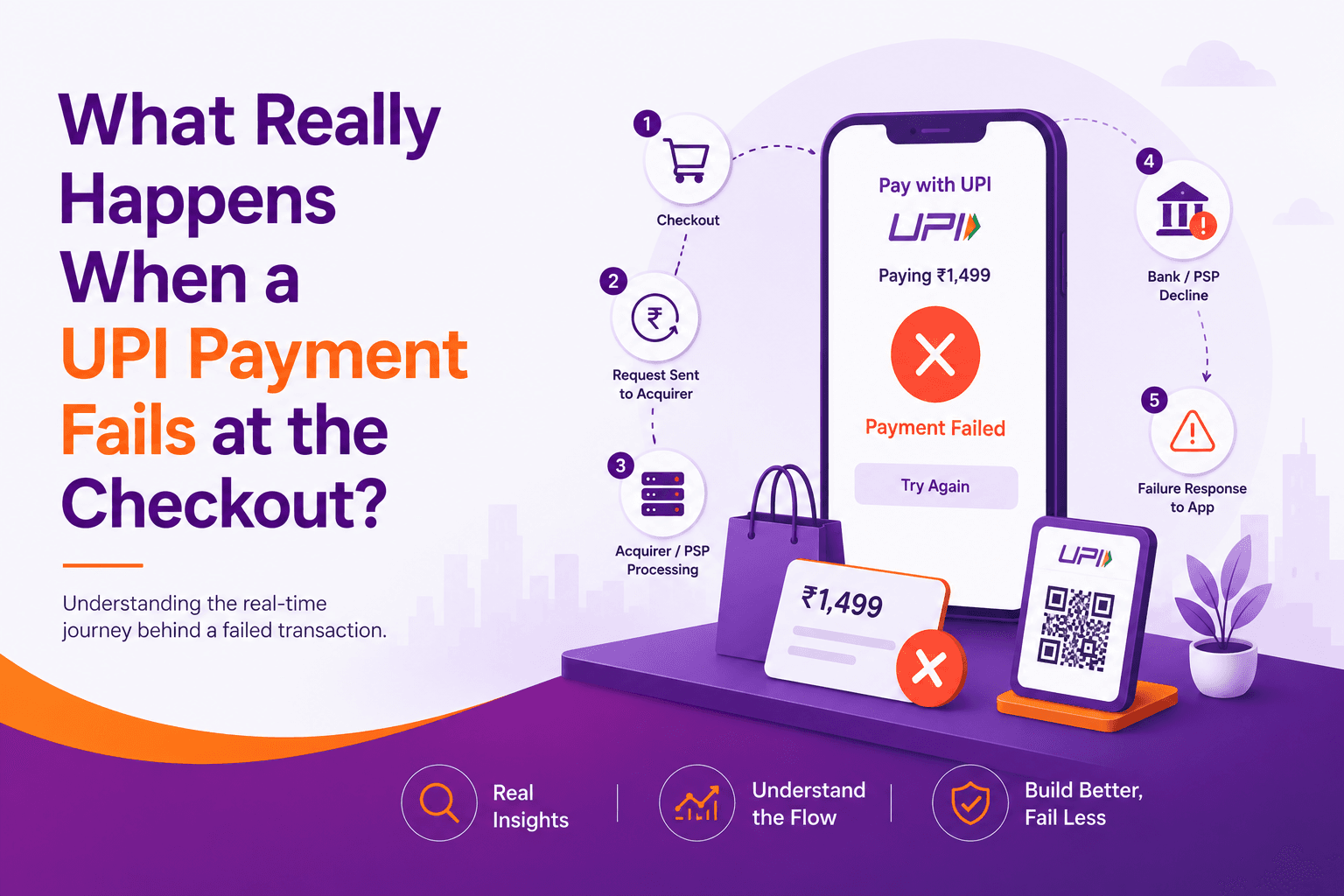
A customer scans a UPI Dynamic QR at the checkout counter. The payment fails. He tries again, and it fails again. Now, the customer has a simple choice – try another payment method or leave without completing the purchase.
In organized retail, this moment may look like a small payment inconvenience. For the merchant, however, it can have a bigger financial impact.
When a UPI transaction fails, the customer may switch to a credit card to complete the purchase. The sale still goes through, but the payment now moves to a transaction that carries a Merchant Discount Rate (MDR). This means a UPI failure can incur costs that extend beyond the failed transaction itself.
A UPI Failure Does Not Always Mean a Lost Sale
Innoviti’s analysis of 5.93 million transactions across a cohort of 5 hypermarket stores highlights an important pattern. During the observation period, the stores recorded 358,807 UPI failures. The data also showed that for every 100 UPI failures, around 10 resulted in a card transaction within 90 seconds at the same checkout counter.
The customer was still willing to buy. The problem was the payment experience. For the retailer, however, the payment method had changed. A transaction that could have remained on zero-cost UPI was converted to a card transaction, incurring an MDR exposure of around 90-150 basis points. At high transaction volumes, repeated payment migrations can become a high cost for the merchant.
Why Manual Acquirer Switching Is Not Enough
Retailers are often left with limited options when a UPI transaction fails. Store staff can manually switch the UPI acquirer through the EDC terminal and ask the customer to try again. Alternatively, the customer can simply use a card and complete the purchase.
The problem is timing. Manual switching happens after the payment has already failed. By then, the customer has experienced the failed transaction. They may decide to use a card rather than wait for another UPI attempt. This makes the process reactive.
The more useful question is not:
“How do we recover after a UPI failure?”
It is:
“How do we identify an acquirer problem before it causes a UPI failure?”
That is where pre-emptive acquirer routing becomes important.
What is Pre-Emptive Acquirer Routing?
UPI Dynamic QR payments require the right acquirer to be selected before the QR is presented to the customer. Innoviti unipay’s UPI Acquirer Backup Platform uses AI-driven monitoring to continuously assess the behaviour of connected acquirers.
When the platform detects that an acquirer is behaving differently from its normal pattern, it can route new UPI Dynamic QR traffic to a healthier acquirer.
The customer does not need to do anything differently.
The store team does not need to switch the acquirer manually.
The intervention happens before the next dynamic QR reaches the checkout counter.
The platform takes action before the next UPI transaction is initiated, helping prevent an acquirer issue from turning into a customer-facing payment failure.
Innoviti describes this as India’s first AI-driven, pre-emptive acquirer-backup application designed specifically for in-store UPI Dynamic QR in organized retail.
How Does It Work?
The process is designed to operate continuously in the background.
1. The platform monitors acquirer behaviour
Innoviti unipay continuously monitors connected acquirers and tracks their performance over time.
2. It identifies unusual behaviour
Using AI and unsupervised learning, the platform identifies deviations from an acquirer’s normal behaviour.
3. It redirects new QR traffic
When an acquirer begins to show signs of deterioration, new UPI Dynamic QR code generations can be routed to a healthier connected acquirer.
4. The primary acquirer is checked again
The platform continues monitoring the situation and revalidates the primary acquirer every 30 minutes. This creates a proactive approach to UPI reliability. Instead of waiting for customers to experience payment failures, the payment infrastructure responds to signs of a problem earlier.
What did Innoviti’s Deployment Achieve?
The test results show why this approach matters. During the period of study, the platform intercepted 43,172 UPI transactions and rerouted them to a healthy acquirer.
Of approximately 44,000 UPI transactions intercepted and rerouted during the observation window, around 98% completed with the healthy acquirer. That means the platform was able to redirect transactions away from an unhealthy payment route and keep them moving through a healthier one.
The Benefit Goes Beyond Avoiding Failed Payments
The value of pre-emptive routing is not limited to improving the success of individual UPI transactions. It addresses three connected business concerns.
Better checkout experience
Customers are less likely to experience UPI failures when new QR traffic is moved away from an acquirer showing signs of deterioration.
Lower payment processing costs
Keeping more transactions on the intended UPI rail can reduce the need for customers to switch to card payments after a failure. Based on Innoviti’s deployment data, the platform has reduced digital payment processing costs by up to 6%.
Less manual intervention
Store teams do not need to monitor acquirer health or manually switch the acquirer every time a UPI transaction fails. The routing process works within the payment infrastructure.
The Bigger Picture
UPI has become an important part of the retail payment experience. As transaction volumes grow, payment reliability becomes just as important as payment acceptance. A failed UPI transaction does not always end in a failed sale. Sometimes, the customer simply switches to a card. That change may keep the checkout moving, but it also increases the merchant’s payment cost.
Innoviti unipay’s UPI Acquirer Backup Platform takes a pre-emptive approach to this problem. At scale, the opportunity becomes even larger. For organized retailers, improving UPI reliability is therefore not simply about making payments smoother. It also supports better payment economics and reduces the operational burden of handling checkout failures.